
UEE Akamkpa Hosts Capacity Building Workshop to Enhance Staff Digital Skills for Portal Utilization and AI-driven CBT Question Design
By Imoke Etorti, Ph.D. | April 14, 2026 | Akamkpa, Cross River State
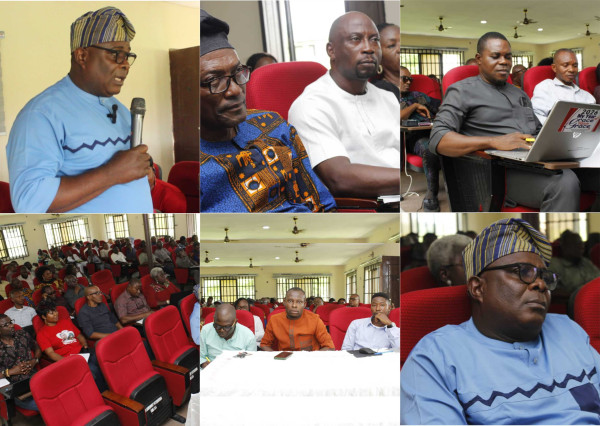
The University of Education and Entrepreneurship (UEE), Akamkpa, on April 14, 2026, held a one-day capacity-building workshop at the University Senate Chamber, themed “Strengthening Academic Staff Digital Skills for University Portal Utilization and Global Visibility.” The training was designed to enhance staff competence in the effective use of the University portal and Artificial Intelligence to improve academic delivery, administrative efficiency, and to strengthen the institution’s global visibility in line with its smart campus vision.
Addressing the high-profile participants at the training workshop, the Vice-Chancellor of the University, represented by the Deputy Vice-Chancellor, Assoc. Prof. Benedict Ugbong, warmly welcomed all participants and expressed delight at the relevance of the workshop theme.
He noted that in today’s rapidly evolving digital era, the integration of technology into teaching, learning, research, and administrative processes is no longer optional but essential. He emphasized that the University portal serves as a central platform designed to enhance efficiency, strengthen communication, and streamline academic activities such as course management, result processing, student engagement, and data administration.
Assoc. Prof. Ugbong further described the workshop as both timely and highly relevant, as the University continues to build capacity and bridge existing digital skill gaps among academic staff, equipping them with the competencies required to function effectively within a modern academic workplace and the global knowledge space.
He stressed that for the University to fully achieve its mandate of producing educators, entrepreneurs, leaders, and innovators who are self-reliant, job and wealth creators, academic staff must continuously take advantage of professional development opportunities to strengthen their digital literacy and align with the University’s smart campus vision.
He expressed appreciation to the University Management for approving the training and, on behalf of the Vice-Chancellor, formally declared the workshop open and expressed confidence that the knowledge gained would translate into improved service delivery, enhanced academic productivity, and a more digitally responsive university system.
Speaking at the training, the Director of the Centre for Teaching and Learning Excellence of the University, Dr. Imoke J. Etorti, emphasized the importance of Continuous Professional Development (CPD) for academic staff.
He defined CPD as a continuous process of learning aimed at enhancing skills, knowledge, and professional expertise throughout one’s career. According to him, CPD helps to keep skills up to date, improve job performance, foster innovation, build confidence and mastery.
Dr. Etorti further noted that in today’s dynamic world, where new technologies and methodologies constantly emerge, CPD enables professionals to remain relevant and effective.
He also guided participants through various aspects of CPD within the University, CPD benefits, implementation strategies, associated challenges, and the role of the Centre for Teaching and Learning Excellence (CTLE), UEE, in promoting staff development.
He stressed that CPD is essential for academic excellence, noting that investing in staff development is ultimately an investment in institutional growth.
The Director of ICT, UEE, Dr. Victor Etta, in his session on the effective use of the University portal, emphasized the importance of proper onboarding as a prerequisite for seamless access to the system. He guided staff through the login process, highlighting the use of designated usernames and secure passwords to access the portal efficiently.
He further stressed the critical role of institutional email accounts, noting that their consistent use is essential for strengthening official communication and enhancing the University’s online presence and visibility. He therefore urged staff to actively utilize their institutional emails in all academic and administrative engagements.
Dr. Etta also encouraged staff to familiarize themselves with the portal interface and functionalities, and to make optimal use of its features to promote academic excellence, transparency, efficiency, and effective service delivery.
In addition, he highlighted the importance of data accuracy and timely updates on the portal, noting that reliable information management is key to informed decision-making and institutional credibility.
He concluded by urging staff to embrace digital tools as indispensable components of modern academic practice.
Mr. Agrumon Alabi Bassey, a programme analyst, emphasized the importance of accuracy, timeliness, and accountability in using the University Portal. He guided Academic staff on how to efficiently handle results preview, computation, summarization, and submission, stressing the need to avoid errors before final upload.
He explained the workflow of approval and rejection by HODs, encouraging proper verification and adherence to deadlines. In addition, he highlighted best practices in results management and course registration, ensuring data consistency and ease of access.
He advised staff to become familiar with the portal interface, maintain data security, and leverage the system to improve transparency and efficiency in academic processes.
Mr. Bassey Michael Archibong, an AI expert and systems analyst, focused his session on setting Multiple Choice CBT questions using AI, guiding Academic Staff on how AI can be used to design, manage, and evaluate examination questions.
He emphasized that AI tools can reduce the time and stress involved in question generation while improving the quality, variety, and validity of assessment items. He demonstrated how lecturers can generate well-structured MCQs aligned with learning objectives across cognitive levels such as recall, application, and critical thinking.
He also highlighted the importance of effective prompting, showing how clear instructions help AI produce accurate and context-specific questions. In addition, he explained how AI can assist in creating plausible distractors, minimizing ambiguity, and ensuring fairness and standardization.
However, he cautioned against over-reliance on AI, stressing the need for human review, subject expertise, and ethical considerations to maintain academic integrity and avoid bias or errors.
A robust question-and-answer session provided participants the opportunity to clarify key concepts and address practical issues relating to the effective use of the University portal and the setting of Multiple-Choice Computer-Based Test (MCQ-CBT) questions.
The Deputy Vice Chancellor (Administration) was accompanied by the Bursar Dr. Eyo Ekpe, Director Academic Planning Assoc. Prof. Rosemary Agba, Deans of Faculty, Directors of various Academic programmes, Heads of Departments, other Academic Staff, and members of the UEE Network Press, stressing the collective ownership of the transformation agenda.
Imoke J. Etorti, Ph.D.
Director, CTLE, UEE, Akamkpa
