
UEE Akamkpa Advances Smart Campus Vision with EI and AI Training for Workplace Efficiency and Higher Productivity.
By Imoke Etorti, Ph.D.|March 3, 2026 | Akamkpa, Cross River State
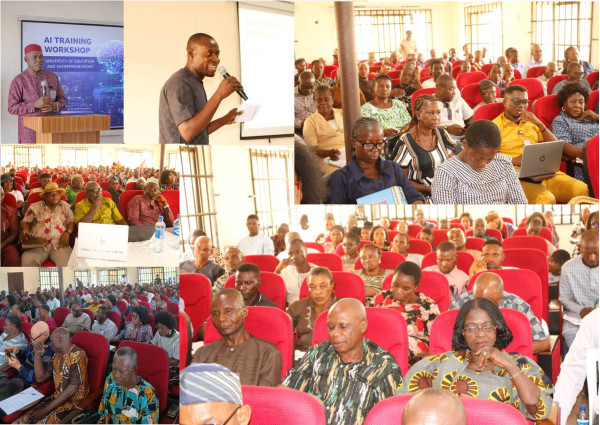
In a decisive stride toward digital transformation and institutional excellence the University of Education and Entrepreneurship (UEE), Akamkpa, has intensified its drive to become a Smart Campus with the hosting of a high-level capacity development training on the theme, "Integrating Artificial Intelligence (AI) and Emotional Intelligence (EI) for Workplace Efficiency and Higher Productivity.”
The training, which brought together academic and non-teaching staff, emphasized the University’s strategic commitment to aligning with global best practices where Artificial Intelligence is deployed to enhance cognitive processes, administrative efficiency, teaching delivery, and research productivity.
Addressing participants, the Vice-Chancellor, Prof. Patrick N. Asuquo, described the initiative as central to the institution’s vision of building a Smart Campus characterized by smart digital tools and smart scholars.
He emphasized that UEE’s transformation agenda is anchored on continuous human capital development through structured staff training.
“AI has come to stay. Institutions across the globe have embraced it to strengthen efficiency and productivity. UEE must not be left behind. What we seek is responsible adoption, compliance, and ethical application of AI tools in our daily operations,” he stated.
The Vice-Chancellor clarified that the University’s focus is not on AI engineering or complex algorithmic development nor on AI scientificism, but on practical applications of AI tools such as ChatGPT, Gemini, DeepSeek, Kimi, and Easemate to support staff productivity, improve service delivery, and promote ethical usage standards.
Citing global developments, he referenced the progressive AI compliance drive in countries such as Rwanda, urging staff to leverage the training to acquire relevant digital skills necessary for institutional growth and competitiveness.
The facilitators, Augustine Ogbaji Otobi, an AI Engineer and Computer Scientist, alongside AI expert and Systems Analyst Bassey Archibong, delivered hands-on sessions demonstrating how AI can serve as a catalyst for workplace efficiency.
Participants were guided through practical AI prompts for: Administrative functions (memos, scheduling, minute-taking, documentation, institutional communication), Teaching support (course outlines, PowerPoint slides, CBT/MCQ questions, essay questions, quizzes, case studies, grading rubrics), Research productivity (paper summarization, identification of research gaps, writing improvement, data interpretation)
They emphasized that AI, when driven by accurate and intentional prompts, can unlock innovative solutions to workplace challenges.
Crucially, the facilitators also highlighted ethical considerations, including academic integrity, transparency, fairness, accountability, and data privacy protection. They stressed that the future of higher education lies in a balanced integration of human intelligence and artificial intelligence.
Complementing the AI discourse was a compelling session on Emotional Intelligence delivered by the Director, Centre for Teaching and Learning Excellence (CTLE), Dr. Imoke Etorti. Referencing the seminal work of Daniel Goleman (1995), Dr. Etorti defined Emotional Intelligence as the ability to identify, understand, and manage one’s own emotions and those of others, essentially subjecting emotion to rational judgment.
He outlined the core components of EI as: Self-awareness, Self-regulation, Self-motivation, and Social skills.
He noted that frequent emotional outbursts disproportionate to situations, persistent arguments, habitual blame-shifting, difficulty listening, and strained relationships are indicators of low emotional intelligence.
Dr. Etorti further identified common workplace emotional triggers within university environments, including work overload, miscommunication, gossip, salary delays, academic pressure, inadequate staffing, and role ambiguity.
He emphasized that Emotional Intelligence is indispensable in higher education because it: Strengthens staff-to-staff and staff-to-student relationships, reduces workplace conflicts, enhances communication, promotes administrative efficiency, builds positive institutional culture, improves leadership effectiveness, prevents burnout and supports stress management.
“Emotional Intelligence is not optional; it is essential for workplace efficiency, improved performance, institutional growth, and sustainable excellence,” he affirmed.
The training featured practical sessions where participants actively engaged with AI tools for academic and administrative applications. A case-study segment further allowed participants to examine real-life workplace scenarios relating to self-awareness, emotional regulation, and relationship management.
A robust question-and-answer session enabled participants to clarify key concepts and explore practical concerns surrounding AI integration and EI application within the University system.
In his closing remarks, the Registrar Amb. Dr. Gabriel Egbe commended the facilitators and participants for their enthusiasm and intellectual openness. He described the training as timely, transformative, and aligned with the University’s digital roadmap. Emphasizing that the journey toward a Smart Campus is continuous, he encouraged departments and administrative units to cascade the knowledge gained, reinforcing the institution’s commitment to innovation.
Artificial Intelligence, he reiterated, is here to stay; and its partnership with Emotional Intelligence is what will define meaningful progress.
Principal officers of the University were present at the event, including the Registrar, Dr. Gabriel Egbe; the Librarian, Dr. Christopher Offem; Bursar Representative, Mr. Egbe Charkpen, Director Academic Planning Assoc. Prof. Rosemary Agba, Deans, Directors, Heads of Departments, Student Union Government, and members of the UEE Network Press, stressing the collective ownership of the transformation agenda.
As the curtains fell on the training, one message echoed clearly across the hall: the future of higher education belongs to institutions that can harmonize Artificial intelligence with human wisdom. With this initiative, the University of Education and Entrepreneurship has signaled its readiness to stand at that intersection, where innovation meets integrity, and productivity is powered by both code and character.
Imoke Etorti, Ph.D.
Director, Center for Teaching and Learning Excellence, UEE, Akamkpa.
